VAA: The Strongest Predictor of Fastball Success
For the longest time, four-seam fastballs were evaluated based on their velocity. Then, as technology improved, they started getting evaluated on their shape, particularly their "carry," or induced vertical break. But I wanted to know what actually is the best predictor of fastball success, so I dove into the data. I pulled every pitcher who threw at least 200 four-seamers in 2025 — a total of 357 — and checked which traits actually predicted whiff rate and contact quality.
IVB barely moved the needle. Velocity and spin rate had a real but modest relationship. The trait that mattered more than all three combined: vertical approach angle, or VAA — essentially how flat or steep the ball crosses the plate. VAA is mostly a function of release point and location — fastballs from a lower release point and thrown higher in the zone will have flatter VAAs.
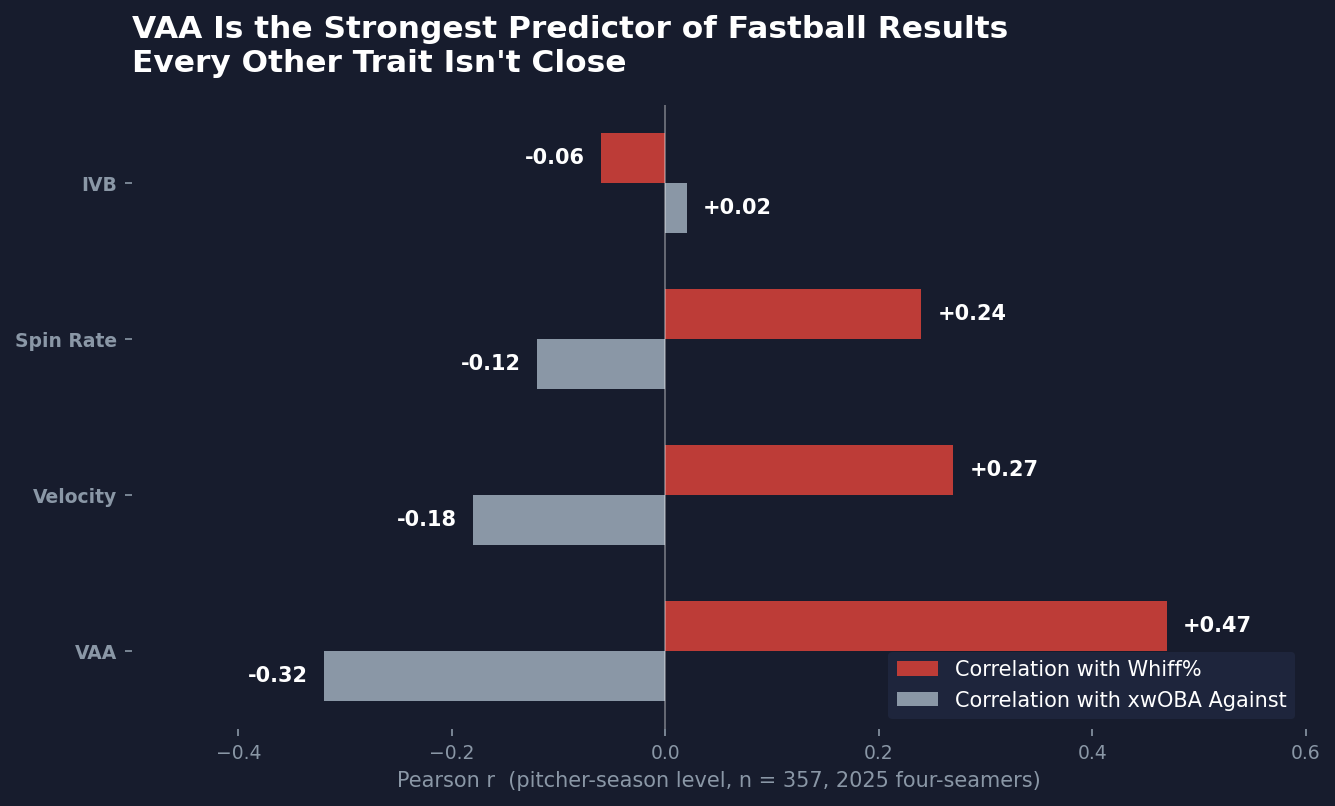
Two real examples make the broader point better than any correlation number: Joe Ryan and Logan Webb both sit in the bottom third of the league in velocity and IVB — an "average shape" fastball by the box-score version of scouting. But both post elite VAA, and both get elite results — Webb's fastball produced the single best xwOBA against in the entire sample.
That connects to a bigger point: no pitch exists in a vacuum. Webb's sinker is a real weapon in its own right, and it also changes how his fastball plays — a fastball that looks unremarkable on a pure movement chart can be elite once you account for what it's tunneling off of and what the hitter's eyes are already tracking. Judging a fastball purely on its own IVB number, in isolation, misses exactly this kind of case.
The takeaway for evaluation: it's not enough to just look at a movement plot to evaluate a fastball. Release point, location, and approach angle deserve more weight than they get, and no single pitch — including the fastball — should be graded apart from the arsenal it's part of. When scouting pitchers, it's important to look beyond just outlier movement, and chase outlier angles and complementary arsenals.
Download the Full Report (PDF)What's Actually Going On With Walker Buehler
Walker Buehler used to be one of the most promising and exciting young pitchers in baseball. But since his second Tommy John surgery, his results have suffered significantly, going from a top-5 finisher in the Cy Young race to a guy with an ERA over 5. I dove into the data to see what's going on, and if there's a way for him to regain his success, even if his stuff is never the same as it was before surgery.
His stuff has genuinely diminished, not just shifted around. He's throwing about 2 mph slower across the board on every pitch compared to 2021, he's lost real carry on his fastball, and he's lost the unique cut-ride shape that used to define it. His arm slot has also dropped from 51 degrees in 2021 to 45 degrees in 2026 — six degrees lower — which likely explains a lot of the shape change.
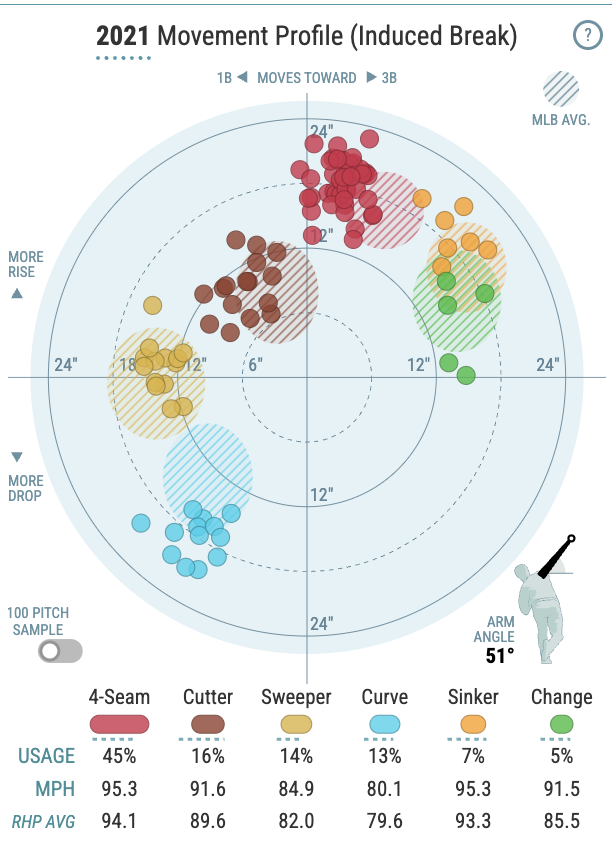
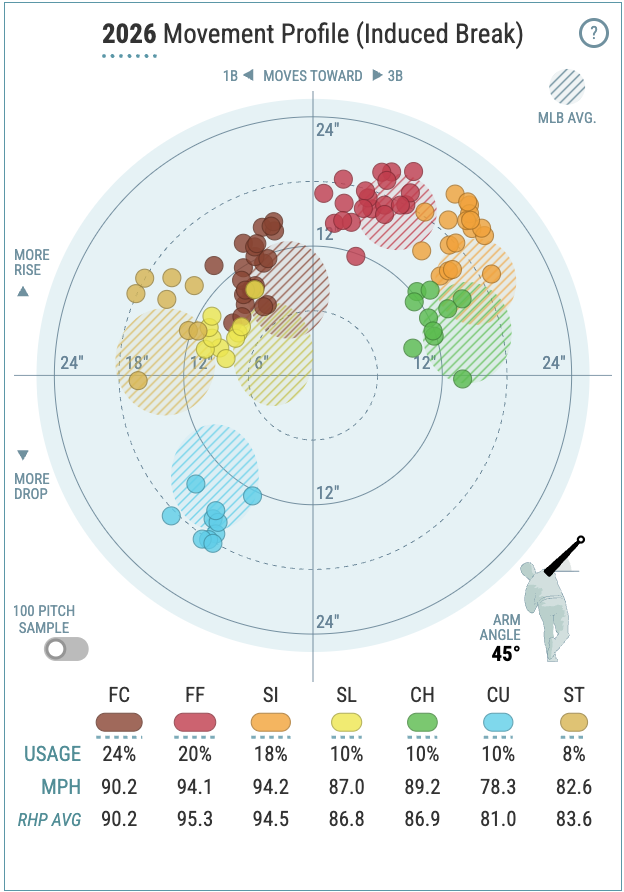
His cutter and changeup, graded purely on their own shape, actually look about the same or arguably better in a vacuum than they did in 2021. But their real performance has collapsed — cutter whiff rate down from 29.2% to 21.7%, changeup down from 33.3% to 16.7%, nearly cut in half. The reason isn't the individual pitches, it's that they no longer tunnel off the fastball the way they used to, because the fastball itself has changed and slowed down.
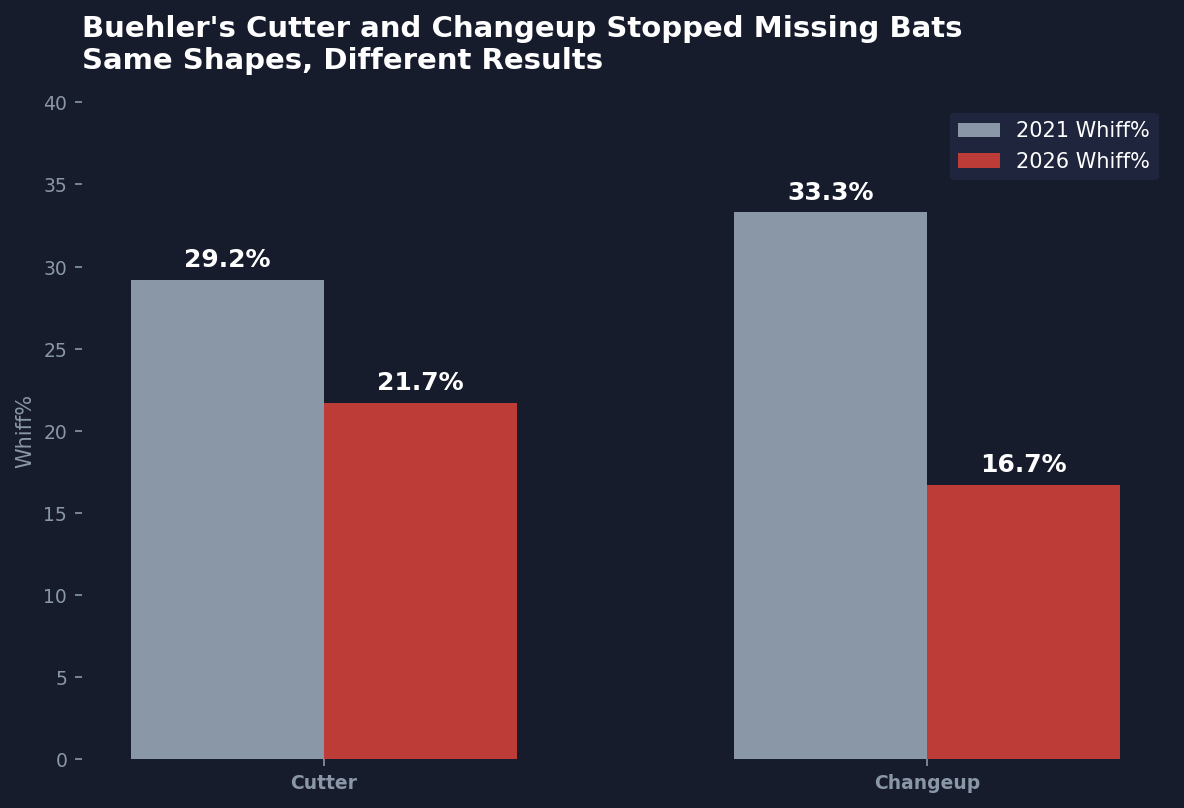
So if his old stuff isn't coming back, what can he actually do? Three things, all process rather than physical:
- Stay ahead in counts. His first-pitch strike rate is still well above league average to both righties and lefties, but his Early-and-Ahead and Ahead-count rates are below average — meaning he's not converting that first-pitch edge into staying ahead deeper into at-bats, and both of those numbers are tied directly to strikeout and walk rate.
- Change his two-strike pitch selection. With two strikes against right-handed hitters, he's going to his fastball 38% of the time and getting under an 8.5% whiff rate on it — that's a pitch that isn't playing anymore, and he should be leaning into his sweeper and slider instead. Against lefties, he should keep pushing the cutter, slider, and changeup rather than going back to the diminished fastball.
- Optimize location by hand, deliberately. To lefties, he's living down and in with his four-seam fastball — the worst location for it based on pitch run value. And his cutter is concentrated at the heart of the plate. Elevating the fastball and getting the cutter to the edge can help him limit damage and may generate more swings and misses. To righties, everything he's throwing is to the glove side. He doesn't have to live on the inner third, but he does need to go there occasionally to keep hitters from getting comfortable leaning over the plate and cheating to the outer half.
None of this brings back his 2021 stuff. But it's the version of "be effective anyway" that's actually available to him right now, and it's exactly the kind of adjustment that keeps a diminished arm firmly rosterable instead of finished.
Download the Full Report (PDF)You Should Be Throwing More Glove-Side Sinkers
Conventionally, pitchers are taught to start their sinker down the middle and let it run to the arm side. And they're told to avoid throwing it to opposite-handed hitters. But I dove into the data to see if this thinking is actually supported, and it's not. Glove-side sinkers outperform sinkers in any other location in the strike zone, in all four batter and pitcher handedness combinations.
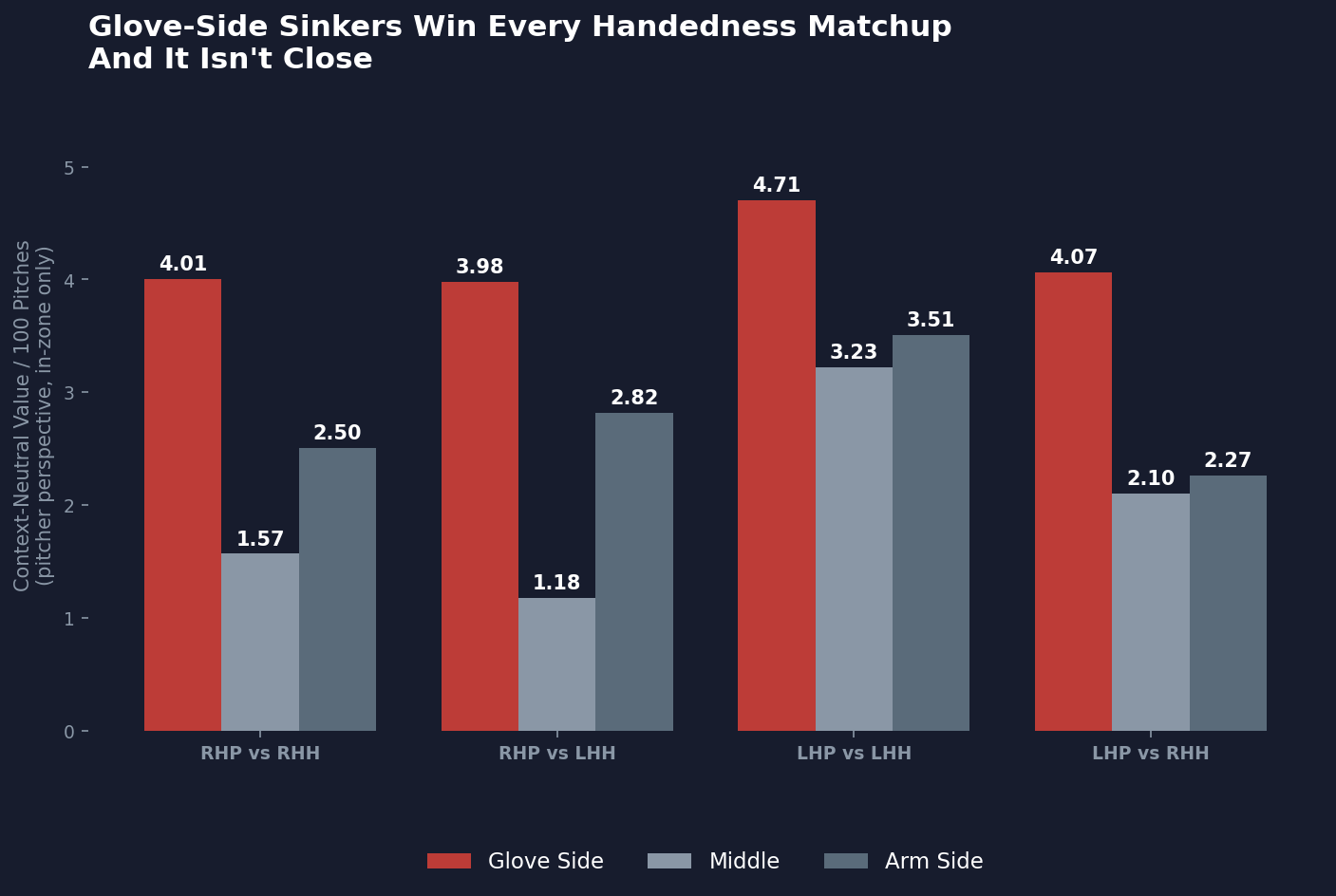
The gap isn't subtle. In righty-vs-righty matchups, a glove-side sinker in the zone was worth 4.01 runs per 100 pitches to the pitcher, versus 1.57 for middle and 2.50 for arm-side. Every other handedness combination — including the two "opposite-handed" matchups pitchers are typically told to avoid sinkers in altogether — shows the same shape: glove-side on top, middle consistently the worst location, arm-side in between.
Here's the mechanism. A sinker runs arm-side as it travels, so a sinker that ends up glove-side had to start out of your hand looking like a ball — well off the plate. The hitter reads "ball" and takes it. If the movement brings it back for a strike, that's a free strike: no swing, no risk of contact. Flip it: a sinker that ends up arm-side in the zone looked hittable out of your hand — closer to middle — so the hitter reads strike and swings, and if it doesn't move enough to get off the barrel, that's exactly the contact that turns into a hard-hit ball.
To be clear, arm-side sinkers that finish off the plate still play fine — that part of the traditional approach works as advertised. But glove-side sinkers are an under-utilized pitch that most guys never even work on. It's low-hanging fruit that can steal strikes and keep hitters off balance, just by changing the sights.
Download the Full Report (PDF)What It Actually Takes to Sign Out of Indy Ball
When I was getting ready for my first indy ball season in 2021, I thought I'd have to be perfect to get picked up by a major league organization. Based on what I saw on TV or heard from the pro guys at my facility, I thought everybody in affiliated ball had a fastball in the upper 90s. And since I didn't, I thought I'd need to be flawless to get a look, and that every run I gave up might cost me my shot. But I got signed after six weeks, which made me wonder what teams are actually looking for when they're scouting indy ball pitchers.
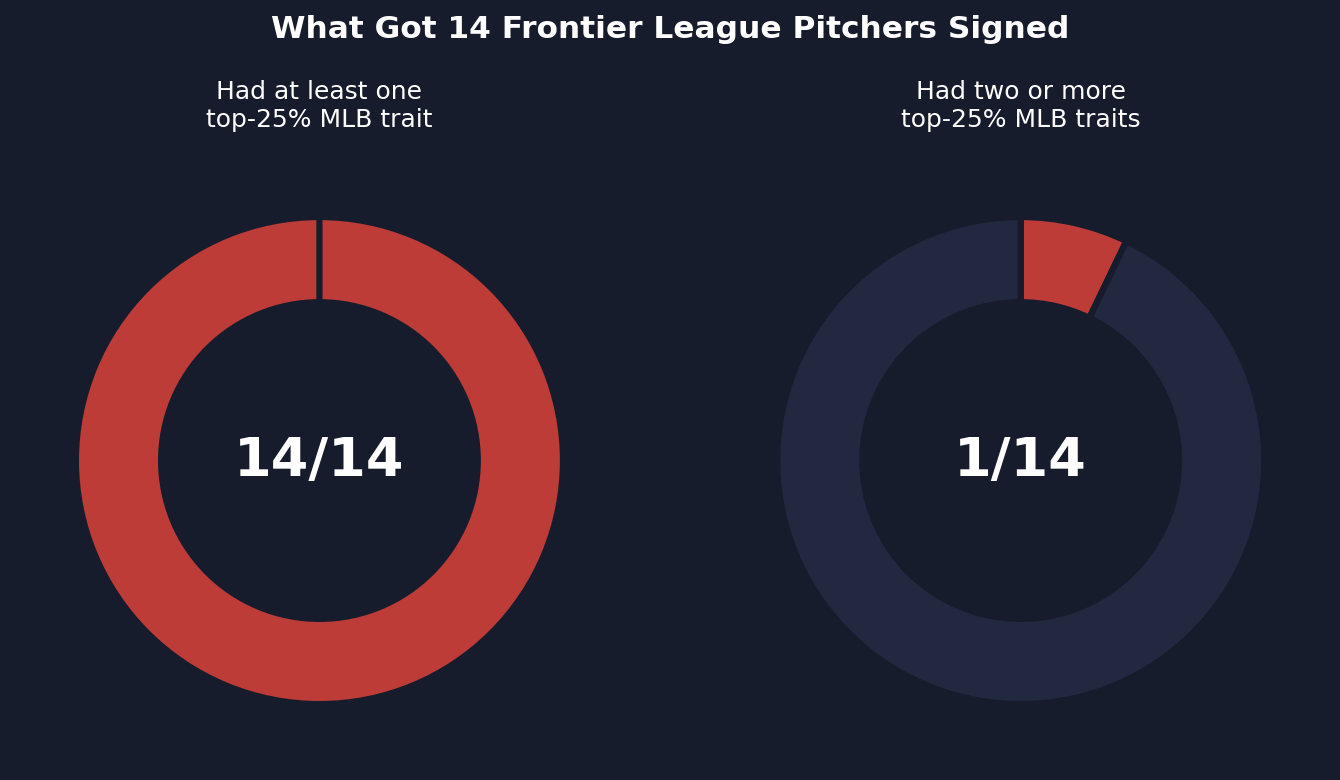
So I looked at the 14 Frontier League pitchers who had been signed by July of this year, compared to major league data from 2025. Every single one of the 14 had at least one trait that graded in that top-25% range — elite carry on the fastball, an outlier breaking ball, a depthy changeup, or velocity most guys never touch. Only one of the 14 had two such traits at once. Nobody in the group was a complete, unhittable package, and almost nobody was actually sitting 95+. Getting outs consistently opens the door — but what actually gets you signed is having one real, data-confirmed weapon, not the number you convinced yourself you needed.
Download the Full Report (PDF)